How Car Wreckers Test Parts Before Selling Them
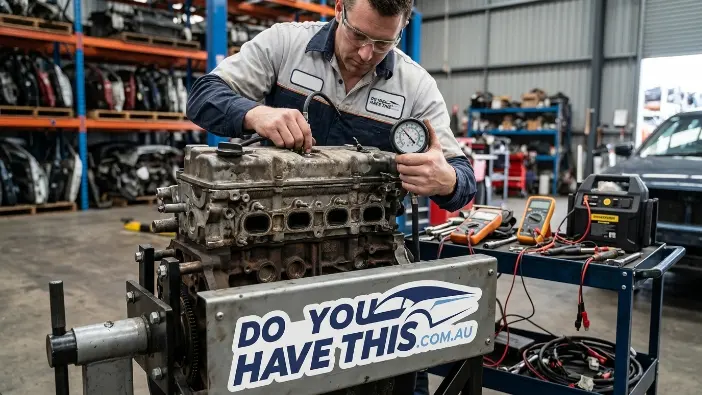
If you've ever bought a used part for your car, you've probably wondered: how do wreckers test car parts before they end up on the shelf, and can you actually trust that they work? It's a fair question. The used parts industry doesn't always get a great reputation, mostly because people imagine a yard full of rusted panels being sold "as is" with fingers crossed.
In reality, most reputable wreckers in Australia run a fairly methodical process before a part is cleared for sale. It's not glamorous, and it's rarely talked about, but understanding it can change how you feel about buying second-hand. It can also help you ask better questions when you're shopping around, because not every wrecker tests to the same standard.
This is especially important when you're dealing with major components like a fuel pump replacement guide, where proper inspection and testing can make a big difference in performance and reliability.
This post walks through what actually happens behind the scenes — from the moment a vehicle arrives at a yard to the moment a part is boxed up and handed over to a customer.
Why Testing Matters More Than People Realise
A car that's been written off or sent to a wrecker isn't necessarily a car full of broken parts. Often, a vehicle is wrecked because of one major issue: a smashed front end, a flooded interior, a blown engine while dozens of other components are completely fine. The challenge for a wrecker is figuring out exactly which parts survived and which didn't.
In reality, most reputable wreckers in Australia run a fairly methodical process before a part is cleared for sale. It's not glamorous, and it's rarely talked about, but understanding it can change how you feel about buying second-hand. It can also help you ask better questions when you're shopping around, because not every wrecker tests to the same standard.
This matters even more when you're planning to buy car parts online in Australia, where you don’t physically inspect the part yourself and must rely on the seller’s testing and honesty.
For buyers, this matters because it directly affects how much confidence you can have in a part and how much risk you're taking on if something goes wrong after you fit it.
How Auto Wreckers Test Parts in Australia: The General Process
While every yard runs things slightly differently, the overall workflow tends to follow a similar pattern.
1. Initial assessment on arrival
When a vehicle comes into the yard, it's usually given a once-over before anything is removed. This includes checking the service history if available, looking at obvious damage, checking fluid levels and colour, and noting anything unusual, strange smells, warning lights still illuminated, or signs of previous repairs.
2. Component-by-component inspection
Rather than treating the car as a single unit, experienced dismantlers assess each major system separately: engine, transmission, electronics, suspension, body panels, glass, interior trim, and so on. A car written off for panel damage might still have a perfectly healthy engine and electrical system, and that's often where the real value lies.
3. Functional testing before removal
Where possible, parts are tested while they're still in the vehicle, because this is often the most accurate way to assess them. An engine that starts, idles smoothly, and runs through the gears tells a dismantler far more than a part sitting on a shelf ever could.
4. Removal and secondary testing
Once removed, many parts go through a second round of testing this time isolated from the rest of the car. This is particularly important for electronic components, where a fault in one part of the car can sometimes mask or mimic a fault in another.
5. Cleaning, grading, and labelling
After testing, parts are usually cleaned, photographed, and graded based on condition. Labelling often includes the donor vehicle's details: make, model, year, VIN-linked information, which matters for compatibility and warranty purposes.
This becomes even more important when dealing with car parts shipping across different regions, where buyers rely on accurate information to ensure they receive the correct part without being able to inspect it in person.
This is the broad shape of how wreckers inspect used car parts, though the depth of testing varies a lot depending on the part itself, which is where things get more interesting.
How Do Wreckers Test a Used Engine?
Engines are one of the highest-value items in any wrecking yard, and also one of the riskiest to get wrong, which is why they tend to get the most thorough attention.
Visual and fluid checks come first. Before anything is started, the oil is checked for colour, consistency, and any signs of metal particles or coolant contamination (a milky appearance can indicate a blown head gasket). Coolant is checked for oil contamination too, since that can point to internal issues.
Compression testing is one of the most telling checks. Each cylinder is tested individually, and the readings are compared against each other rather than just against a textbook number. If one or two cylinders read significantly lower than the rest, that's usually a sign of worn rings, a damaged valve, or head gasket trouble.
A run test under load is the next step where possible. The engine is started, brought up to operating temperature, and checked for unusual noises, knocking, ticking, or rattling that could indicate bearing wear or timing chain issues. Idle stability, exhaust smoke colour, and oil pressure readings are all part of this check too. Blue smoke often points to oil burning, while white smoke can suggest coolant entering the combustion chamber.
Electrical and sensor checks round things out, since a modern engine is as much about its sensors and wiring as it is about the mechanical components underneath.
If an engine passes these checks, it's generally considered a tested runner, meaning it ran and performed within normal parameters at the time of removal. It's worth noting that this is different from a guarantee that it will run forever; it's an honest snapshot of condition at the point of testing, which is exactly why reputable sellers are upfront about this distinction.
Even small interior upgrades like looking for floor carpet for Honda Jazz follow the same ideal: condition and proper matching at the time of listing matter more than assumptions about long-term use.
How Do Wreckers Test a Used ECU?
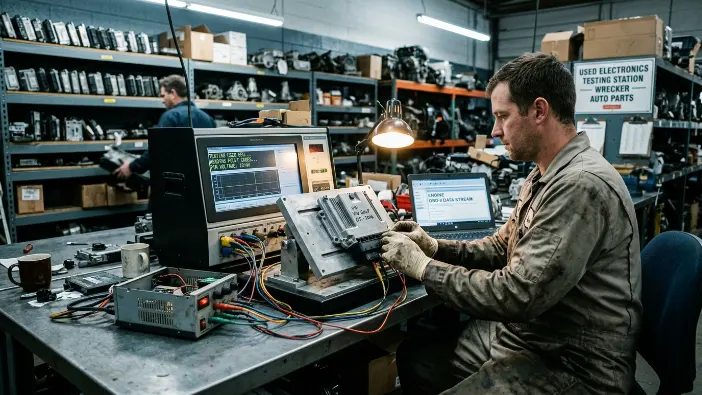
The engine control unit (ECU) is one of the trickier parts to assess, because a "working" ECU on the bench doesn't always mean it's right for your car.
Fault code scanning is the starting point. Before removal, the ECU is connected to a diagnostic scanner to check for stored fault codes. This helps identify whether the ECU itself has triggered any internal errors, or whether codes relate to other components entirely.
Compatibility verification is just as important as functionality. ECUs are often tied to a vehicle's VIN, immobiliser system, and sometimes even specific transmission or engine variants. A wrecker testing an ECU isn't just asking "does it power on?" They're also confirming it matches the part number, software version, and vehicle configuration needed for it to actually work in a different car of the same model.
Bench testing, where available, allows the unit to be powered up independently to confirm it boots correctly and communicates over the vehicle's network (commonly CAN bus on newer cars) without throwing internal faults.
Because of immobiliser pairing on many modern vehicles, some wreckers will also note whether an ECU is "virgin" (never paired) or already linked to a specific vehicle, since this affects whether it can simply be swapped in or whether it needs reprogramming by a locksmith or dealer.
How Do Wreckers Pressure Test a Radiator?
Radiators look simple from the outside, but small leaks can be surprisingly hard to spot with the naked eye, especially hairline cracks near seams or tank joints.
A pressure test is the standard method. The radiator is sealed and pressurised with air or water to slightly above normal operating pressure, then left for a period of time while the technician checks for any drop in pressure or visible signs of leaking bubbles in a water bath, or wet spots on the radiator itself.
Visual inspection of fins and tanks happens alongside this. Bent or corroded fins can affect cooling efficiency even if the radiator doesn't leak, while plastic tanks (common on many modern radiators) are checked for cracking around the seams where they meet the metal core.
Cap and thread checks are also part of the process, since a radiator that holds pressure perfectly well but has a damaged cap seat or stripped fitting can still cause cooling problems once installed.
A radiator that holds pressure steadily for the test period, typically without any measurable drop, is considered sound. This is one of the more reassuring tests from a buyer's perspective, because pressure testing is genuinely good at catching the most common failure point (leaks) before the part ever leaves the yard.
Common Misunderstandings Buyers Have
A few misconceptions come up again and again when people talk about buying used parts.
Tested" doesn't always mean "brand new condition". A tested part has been checked and found to be functioning within acceptable parameters; it doesn't mean it has zero wear. An engine with 150,000km on it can absolutely pass a compression and run test while still having normal wear consistent with its age.
Electronic parts can pass a basic test but still be wrong for your car. This is especially true for ECUs, body control modules, and similar components. Two parts can look identical and even power on correctly, but if the software version or coding doesn't match your vehicle, it won't work properly or at all.
Not every part gets the same level of testing. High-value items like engines, transmissions, and ECUs usually get the most attention because the cost of getting it wrong is highest. Smaller items
door handles, mirrors, trim pieces are more likely to be checked visually rather than functionally tested in depth.
Why Experience Makes the Difference
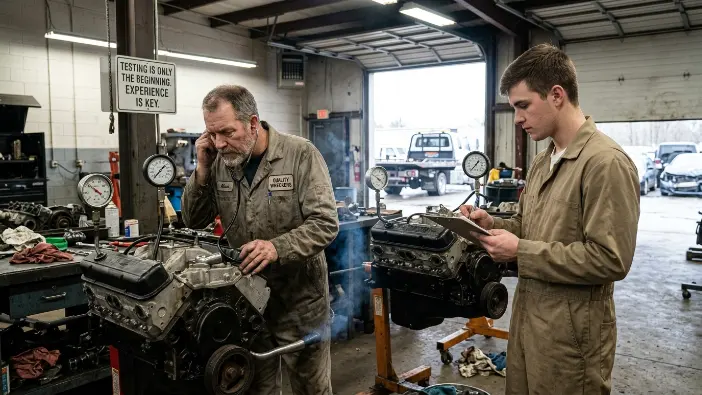
A lot of testing comes down to interpretation, not just equipment. Two engines might both "pass" a compression test, but someone experienced enough to also notice a slightly irregular idle, a faint smell from the exhaust, or an oil pressure reading that's a touch lower than expected can catch issues that a basic checklist would miss.
This is really the value that a good wrecker brings: not just running the tests, but knowing what the results actually mean in context, and being honest about the limitations of what testing can and can't tell you. No test can predict how a part will hold up over years of driving, but a thorough one can rule out the obvious problems before a part ever reaches a customer.
That’s especially important when sourcing specific components like the Nissan Dualis 5 Seater AWD Rear Drive Shaft, where correct matching and proper testing directly affect safety, drivability, and long-term reliability.
conclusion
So, how do wreckers test car parts? In short: through a mix of visual inspection, functional testing, and for higher-value components, specific checks like compression testing for engines, fault code scanning and compatibility checks for ECUs, and pressure testing for radiators. The goal isn't to promise perfection; it's to give buyers an honest, informed starting point.
If you're shopping for a used part, it's reasonable to ask a wrecker what testing was done before the part was listed. A straightforward answer, including any limitations, is usually a good sign you're dealing with a yard that takes the process seriously.
FAQs
Does a "tested" engine come with any kind of guarantee?
Testing confirms the engine was running and within normal parameters at the time it was checked. Many sellers also offer a short warranty period separate from the testing itself, so it's worth asking what's covered and for how long.
Can a used ECU just be swapped straight into my car?
Sometimes, but not always. Because ECUs are often linked to a vehicle's immobiliser and software configuration, compatibility checks matter as much as functional ones. A wrecker should be able to tell you whether a unit needs reprogramming before it'll work.
Why do radiators get pressure tested instead of just checked visually?
Small leaks, especially hairline cracks near seams, are often invisible to the eye but become obvious under pressure. It's a quick test that catches the most common cause of radiator failure.
Is a part with no fault codes definitely fine?
Not necessarily. Some issues like minor wear, slow leaks, or intermittent faults don't always trigger a stored code. A clean scan is a good sign, but it's one piece of the picture rather than the whole story.
What's the difference between a tested part and an "as is" part?
A tested part has been through some form of functional check and passed within normal parameters. "As is" parts are usually sold without that testing, often at a lower price, and the buyer takes on more of the risk.